The 3rd Alternative by Stephen R. Covey
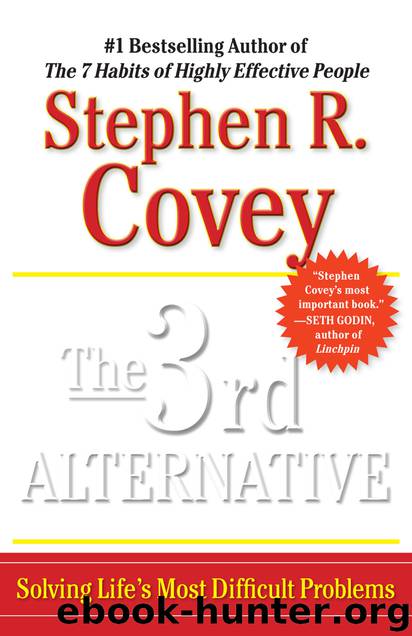
Author:Stephen R. Covey
Language: eng
Format: azw3, epub, mobi
Publisher: Free Press
Published: 2011-11-14T16:00:00+00:00
Two Sides of an Eagle Feather
In Canada there are more than six hundred bands of Indians known today as the First Nations. Many First Nations people want to join the mainstream, to get schooling and good jobs, but they also want to hold on to their own ancient ways. For years, the authorities tried to educate them to Western ways and guide them out of their native cultures. But post–high school education has had a dismal record among the First Nations. Teachers reported that students simply would not participate in class; they would stare at the floor and speak so little and so quietly they could not be heard. Only a very few ever graduated with anything like a college degree. They have been stereotyped as primitive or backward, unable to cope with the complex demands of modern civilization.
This dilemma helps explain the so-called achievement gap in our schools that we hear so much about. Minority students chronically fall behind on skills tests, yet they are as capable of learning as anyone. But imagine how you would respond if aliens took over your town, forced you into their schools, and tested you on your mastery of their cultural wisdom and knowledge. Imagine further that these aliens consider only their own culture worthwhile and your culture to be valueless. Is it just possible that a lack of empathy might partially account for the achievement gap?
Caught in this cultural clash but unwilling to give up, the tribal councilors of Meadow Lake, Saskatchewan, approached Professors Jessica Ball and Alan Pence of the University of Victoria to help them develop courses in childhood development for the young families among their nine tribes. They were deeply worried about unemployment and exploding drug and alcohol abuse among the youth of the First Nations and wanted to help parents develop new patterns for raising children.
Because the experience of the First Nations with the Canadian educational system was not promising, Ball and Pence, both child-development experts, decided to listen to the people first instead of just dispensing a solution. They brought together tribal elders, parents, and other community members to hear their concerns. These people at last had an opportunity to use their voices, some for the first time. All sides shared their perspectives, including the professors, and by this route they arrived together at a new curriculum unlike any other for a college degree in child and youth care. It was a 3rd Alternative curriculum that combined the wisdom of both the indigenous “words of the Elders” and the Euro-American “words of the West.”158 The students learned Cree and Diné caregiving traditions and practices alongside the mainstream science. When they found that their own traditions were respected, the students began to speak up with new confidence. Furthermore, the curriculum was not set in concrete; insights from the students became part of the course. One teacher called it a “lived curriculum.” Because of their respect for the flood of ideas from the First Nations culture, the instructors agreed not to “preordain exactly where the journey of generating curriculum will lead.
Download
The 3rd Alternative by Stephen R. Covey.epub
The 3rd Alternative by Stephen R. Covey.mobi
This site does not store any files on its server. We only index and link to content provided by other sites. Please contact the content providers to delete copyright contents if any and email us, we'll remove relevant links or contents immediately.
Waking Up in Heaven: A True Story of Brokenness, Heaven, and Life Again by McVea Crystal & Tresniowski Alex(37950)
Still Foolin’ ’Em by Billy Crystal(36500)
Cecilia; Or, Memoirs of an Heiress — Volume 1 by Fanny Burney(32753)
Cecilia; Or, Memoirs of an Heiress — Volume 2 by Fanny Burney(32115)
Cecilia; Or, Memoirs of an Heiress — Volume 3 by Fanny Burney(32095)
Fanny Burney by Claire Harman(26753)
Empire of the Sikhs by Patwant Singh(23226)
We're Going to Need More Wine by Gabrielle Union(19242)
Hans Sturm: A Soldier's Odyssey on the Eastern Front by Gordon Williamson(18738)
Plagued by Fire by Paul Hendrickson(17561)
Out of India by Michael Foss(17044)
All the Missing Girls by Megan Miranda(16843)
Cat's cradle by Kurt Vonnegut(15592)
For the Love of Europe by Rick Steves(15003)
Pimp by Iceberg Slim(14825)
Molly's Game by Molly Bloom(14296)
Bombshells: Glamour Girls of a Lifetime by Sullivan Steve(14245)
Leonardo da Vinci by Walter Isaacson(13551)
4 3 2 1: A Novel by Paul Auster(12646)
